The Bully Buster Book
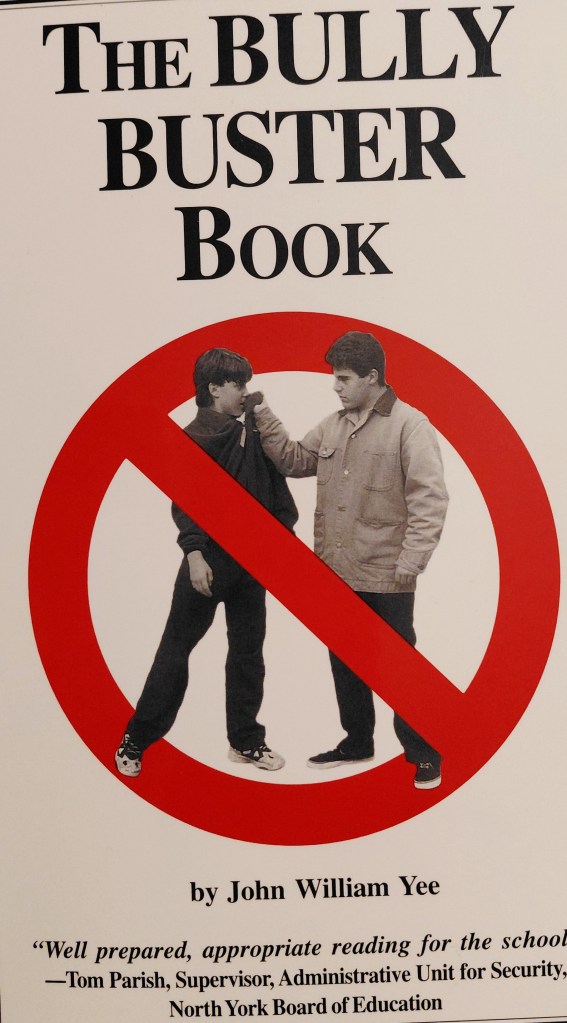
Hushion House, Toronto, ON 128 pages
Applying Fictional Techniques to Get Across an Important Message
Basing a Story on Experience, Skills, and Career
In this book published by Hushion House, I applied fiction techniques such as dialogue and narration to get an important message across.
The subject is based on what I experienced. I had a bullying problem when I was in grade school. I dealt with it by becoming a good friend with the bully’s younger brother. He was an excellent boxer, and he taught me boxing at the boy’s club. I also became very good, and coupled with my friend’s skills, no one dared to bully me anymore.
It is also based on skills I acquired over the decades. In addition to boxing, I learned three different styles of martial arts.
It is also based on my career at that time. I taught martial arts to kids at the City of Toronto’s Parks and Recreation for 10 years. Most of my students had bullying problems. From their stories of how they were being bullied, I got this idea of writing a book on dealing with the problem.
The storyline is as follows: The protagonist was constantly being bullied when he was in grade school. He had this terrifying thought that it would take a long time to ride it out since he was only in grade 6. He decided to take martial arts as a countermeasure. He enrolled in my martial arts school to learn self-defence. But when he decided to test some of the techniques he learned against the bully, he found that it was not effective. He wanted a refund. I reminded him that he hadn’t paid me anything yet. I told him he had to use his brains and not rely just on his brawn. He had to come up with a better strategy, and we worked on that together.
Pace and Mood
The intended audience is older children. Therefore, I had to increase the pace of the story at several spots to maintain attention. I achieved that by keeping the chapters short—especially the first three chapters. I also had to establish the intensity of the mood early. In chapter 1, the protagonist mentioned it was a sickening feeling thinking about him, but lately he thought about him a lot. It was starting to affect his health. In chapter 2, he started to have nightmares about being bullied. He tried to avoid him at school by sleeping in. It worked for a while, but he started to wait for him after class.
Multiple Points of View
I adopted a subjective point of view of the main character. I also applied a second person point of view of the secondary character which is rare in fiction, but it works in this type of fiction where the main character attempts to provide information. The secondary character assists in its dissemination.
Chapter 1 below gives an example of the second person point of view. This POV attempts to solicit the reader to identify with the secondary character who is the victim. Maybe the reader shares similar problems.
Chapter 2 gives an example of a flashback. It further broadens and intensifies the problem for the reader to identify. Most young readers hate flashback, and that is another reason for keeping this chapter brief. The secondary character continues to hold the attention of the reader by means of the second person point of view. That is why I delayed the appearance of the main character until the third chapter.
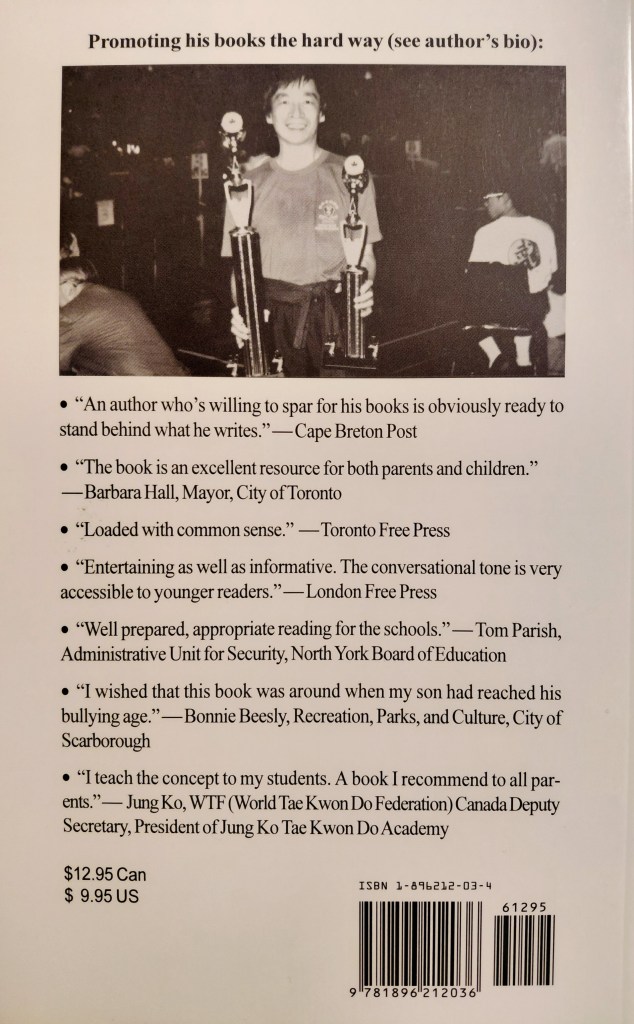
It is possible to push this type of book by improving my skills. Young readers initially equate the merit of such a book on my accomplishments in the ring or in martial arts competition. Sometimes you have to play the game to get the sales out first despite the pain–and focus on the actual message later.
Chapter 1 The Problem
This problem of yours at school — it had nothing to do with your courses, your grades, your teachers, or your friends. That part of your life seemed to go your way. You should be happy, but you were not.
You tried your best to avoid talking to anyone about HIM for a number of reasons. It was a sickening feeling just thinking about HIM, but lately you had thought about HIM a lot.
It was affecting your health. Your parents became a little worried about your discolouration and loss of appetite and strongly suggested that you stay home for a day or two. That sounded OK with you because that meant you would not see HIM for a while.
However, you had another horrible thought: a week had already gone by and you were supposed to get better and go back to school — despite the fact that you still don’t look that great.
“That does it!” you declared. This time you were sure. You were not going to put it off any longer; you were supposed to see me when you had your last encounter with HIM. It all began when . . .
Chapter 2 When You Can’t Take It Anymore
. . . the sort of person who you would hate to meet in a dark alley stood right before you, and you got this funny feeling that you better make a run for it.
Deep down inside, you knew it would be useless. But what else could you do? You had already wasted precious seconds waiting to see if anyone would come to your rescue when it was obvious that no one in their right frame of mind would stand up to HIM.
Your friends watched in horror while HE chased you. You called out to them, but they backed away even farther. They did not want to get involved. None of them wanted to be a hero — especially a dead one.
Everyone felt sorry for you when HE caught up to you and dragged you to a grinding halt with those oversized mitts of his. Then HE started to squeeze. His grip became tighter and tighter, and you could hardly breathe. The next thing you knew, you were in a drowsy, semiconscious, and surreal state.
RINGGGGGG!!!You tried your best to avoid talking to anyone about HIM for a number of reasons. It was a sickening feeling just thinking about HIM, but lately you had thought about HIM a lot.
Saved by the alarm clock again. That was the same nightmare for the last three weeks in a row. Or was it four? You lost count. At first, you treated it as a nuisance and hoped that it would go away, but it didn’t. You were exhausted and drenched in sweat. You wondered how you had gotten into this mess.
It was still dark outside, but the thought of going back to sleep was too dreadful. Your first class was another three hours away; you did not want to think about that either.
How you hate it — not school, but what would most likely take place on your way there. You tried to avoid HIM by sleeping in. It was working, but then HE waited for you after class. That was why you were also constantly late coming home. It was as bad as going to school.
And like your teachers, your parents wanted an explanation. You told them everything but the truth. You wanted to mention what HE did to you, but somehow you couldn’t. HE had said that if you did, HE would really beat you up.
“I’m not going to take it anymore,” you finally decided.
You muttered to yourself that you should have asked for help long ago. You hoped it was not too late. But who would you talk to? A psychiatrist? You wondered if you could afford one with the salary you got these days delivering newspapers. Nevertheless, you continued to thumb through the yellow pages. Clairvoyance, Palm Reading, Tarot Cards, (you’re getting close) . . . Bingo!
Somehow you found my low-budgeted ad which was tucked away in the corner somewhere between Self-Defence and some-sort-of-ology of the self.
Slash Your Weight and Trim Your Abs
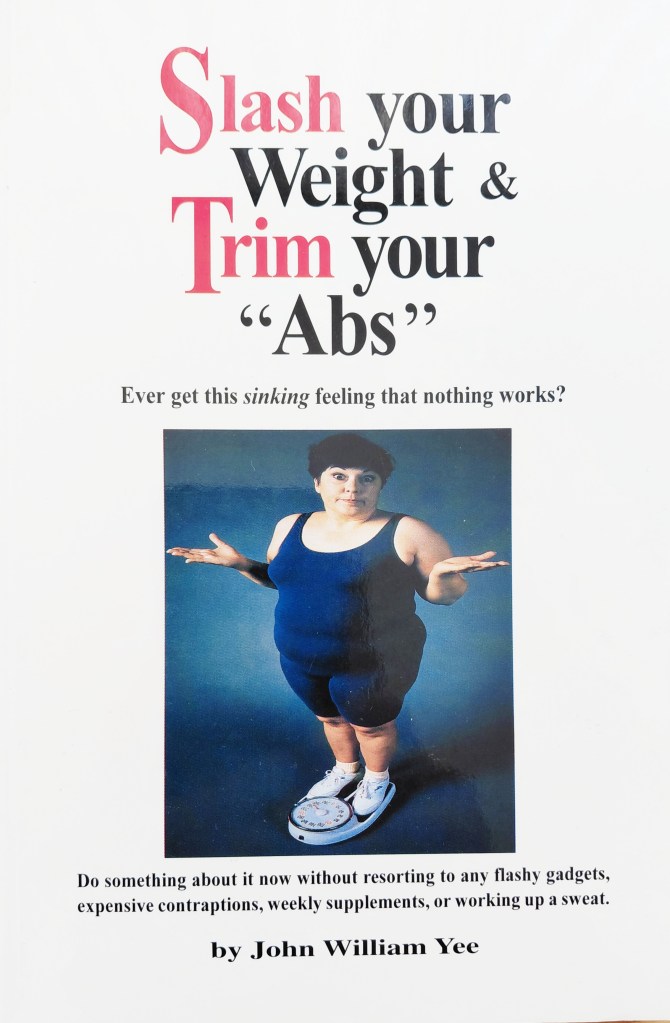
Hushion House, Toronto, ON 128 pages
Applying Fictional Techniques to Get Across an Important Message
In this book published by Hushion House, I applied fictional techniques to enhance the message I want to give on losing weight. It is similar to the application of dialogue and narration in the following books to make them entertaining as well as informative: The Wealthy Barber, The Wealthy Gardner, and Way of the Peaceful Warrior.
The difference between this book and the others I mentioned above is that I applied dialogue and narration more extensively. Another difference is that The Wealthy Barber and the Wealthy Gardner applied fictional techniques to explain something. The explanation is about ways to accumulate more wealth. Way of the Peaceful Warrior applied fictional techniques to describe an unusual phenomenon. The implication is that happiness is derived from living in the present moment.
Although my book also attempts to explain something, I depend on dialogue to get across an argument. I utilize both inductive and deductive styles of argument to get a message across. The common consensus is that someone attempting to lose weight should avoid carbohydrates. But the contention is that a certain amount is necessary if one is active. Carbohydrates are easier to burn compared to protein and fat.
Pace and Mood
Another difference is that I depend on dialogue and narration to determine the pace and the mood of the story. Notice that in the following two chapters the pace of the story moves at a fast clip by keeping the chapters short and the length of the dialogue brief. The mood is that I just opened a fitness studio. Business is slow, and I had to attract clients under the guise of taking a survey in the dead of winter.
Multiple Points of View
Another big difference is that it is written in multiple points of view. As in the previous book, I adopted a subjective point of view of the main character. I also applied a second person point of view of the secondary character. It works in this type of fiction where the main character attempts to provide information.
I also applied the second person subjective POV mixed in with the subject POV of the main character. In the first three paragraphs in chapter 1, for example, I am not referring to you as the reader. I am actually reflecting on someone to myself. Therefore, it is actually a subjective point of view of me who happens to be the main character in this story. It is disguised as a second person subjective POV.
An example of the subjective point of view of the secondary main character is in the fourth paragraph of Chapter 1. He had the horrible thought of buying clothes a size larger in anticipation of gaining more weight. I am addressing you as the reader to become this character. Notice that he said that he is busy, and he is rushing. There is a sense of urgency about him.
If you write in this complicated manner, make sure you let the reader know who is the narrator. In the first paragraph of chapter 2, the narrator is identified as the protagonist.
Chapter 1 A Horrible Thought
Suppose you suddenly realized that you had gained another 10 pounds. In other words, suppose you had done it to yourself again. You tried to restrain yourself during the holidays, but you couldn’t. All that food, friends, and booze proved to be a deadly combination—as far as your weight was concerned.
You did not have such a problem the previous year; your weight would have adjusted automatically—not back to normal mind you, but back to whatever you had weighed before. Although it was above average, it was nothing to sweat over.
But that was back then. The scary thing that kept nagging away at you at the moment was that you might have to change your entire wardrobe.
“Maybe I should start buying clothes a size larger,” you thought in anticipation. “No! No! No!” you said later. That was a horrible thought. It reminded you of cousin Jane who always did that. Whenever you saw her, it often made you wonder what came first: her oversized clothes or her increase in weight.
You decided for the umpteenth time that you should do some exercise. But you had this job that demanded a lot from you. By the time you got home, you just wanted to lay comatose on the couch for a couple of hours—never mind doing jumping jacks or rabbit hops around the living room. Just thinking about it was enough to stress you out, and you were already stressed out.
And dieting was also out of the question. You remembered what happened to cousin Jane who tried it. All that weight she had lost in such a short time—it was like a miracle. Then she stopped for a while when she thought everything was almost back to normal. She had such high hopes, but it all came crashing down after she started putting the pounds back on.
But still—you wished that there was something you could do.
Chapter 2 A Chance Meeting
Your wish was answered although you did not realize it when I stopped you at random. I did not know where all this was going myself, but I knew I had to make a living. Business was slow, and that meant going out to make myself visible and start flogging it. I’ve been doing that for a few days now, and it was starting to get to me—especially after I just ran out of flyers and had to ad-lib. I was wondering if maybe mom was right. Maybe I should have stayed as a desk clerk at—-
Several flashbacks suddenly jolted my memory. It was a rude awakening. I had to remind myself again who I was, what I was doing, why I was doing it, and why I had the nerve to stop you right in the middle of a busy intersection in the dead of winter.
“Excuse me, I’m conducting a survey. Which part of your body do you want to strengthen the most?”
“My midsection,” you responded automatically.
“Are you doing anything about it?”
“I don’t have time. Too busy at the office doing three different jobs at once. By the time I get home, I just want to relax.”
“Would you be interested in a set of ‘washboard abs’?”
“What’s that?”
“It’s fitness terminology. It refers to developing your abdomen until it ripples like a washboard.”
“Didn’t you hear me? I don’t have time. Excuse me,” you said as you tried to zigzag around me.
“But the routine will only take 5 to 10 minutes a day.”
“A lot of good that will do for my weight,” you said without slowing down.
“That’s also part of the course I’m offering,” I said while trying to keep up with you. You were going at a decent pace; regardless of what anyone told you, I didn’t think you had a weight problem.
“I thought this was just a survey.”
“It is. It’ll give me an idea of the level of interest before I offer it.”
“It sounds too good to be true. A two for one deal?”
“Something like that.”
“What sort of ridiculous price are you going to charge me?”
“Allow me to give you my card.” It was the only reply I could think of after you made a dash towards the lineup that was quickly disappearing into the streetcar. “We can talk about it some more at your convenience. My studio is just a few blocks down from here.”
“I’ve been working around this area for ten years, and I don’t remember seeing a fitness studio.”
“It’s new. I just set up shop.”
“I’ll think about it,” you said.
Most of my “surveys” usually ended on that note. But at least there was some interest.
The Promise

This is a book I help edit for publication. It is a novel, and the story is based on the author’s life experience. She was a student in my creative writing course, and I found she was having trouble with some chapters. I helped rewrite most of the content, and the book was eventually published. I was surprise to find that she is an Olympic gold medalist in the 400 m freestyle. She is also a world record holder in the 800 m freestyle. She is a recipient of the Order of Hungary. Her name is Valerie Gyenge
I helped her to contact Milt Dunnell, the former sports writer for the Toronto Star who helped her defect to Canada. I also contacted the Star, and she received coverage for her book.
She wrote in her acknowledgement page:
Many thanks to J. Barbara Rose, the Skills Strategist & Writing Co-coordinator at U of T, for her assistance and counselling during the editing of the final manuscript.
To John William Yee who spend countless hours organizing and finishing the book for the final print.
To Milt Dunnell, former sports writer for the Toronto Star. Without your help, I would not be here, and this book would not have been written.

 According to John